


Paws & Pastries: Merge Café
3.635.00 Reviews
App Specs
- Version
- 1.7.2
- Updated On
- License
- Free
- Downloads
- 10,000+
- Developer
- TreesPlease Games Ltd
- Categories
- Casual
- Platform
- Android
Screenshots



 Analysis by AppCompare
I approached Paws & Pastries: Merge Café expecting a gentle casual game, and that is exactly the kind of experience it aims to provide. Its basic idea combines café decoration, merge-style tasks, animal rescue, and a romantic storyline. That mix gives it a warmer personality than a straightforward matching game, although it also means the appeal depends heavily on whether you enjoy several light systems living together rather than one deep mechanic.
My first impression is that this is best treated as a relaxed, short-session game. You can pick it up when you have a few spare minutes, make progress, and put it down without needing the concentration demanded by a strategy game or the reflexes expected from an action title. The free entry point is helpful for curious players, while the Everyone age rating makes it suitable for a broad audience. I would still remind younger players that optional purchases range from $0.99 to $99.99 per item, so device-level purchase controls are worth considering before handing over a phone.
What the café experience feels like
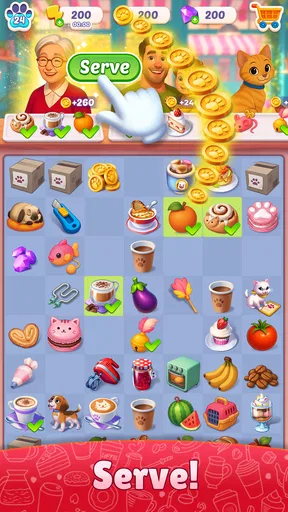
The central attraction is the sense of gradually turning an ordinary café project into something personal. The merge format gives small actions a visible purpose: instead of simply tapping through isolated objectives, I am encouraged to combine items and use the result to move the café forward. That creates a pleasant rhythm. I can make a few combinations, check what they unlock for the current task, and then decide whether to continue or save my energy for later.
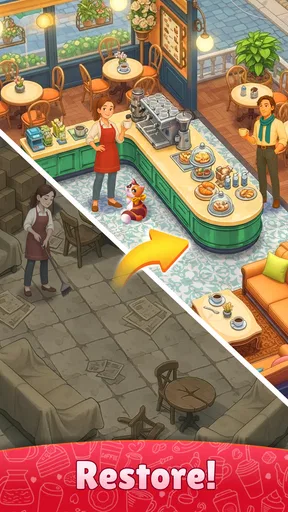
The café setting also gives the game a clearer emotional direction than a purely abstract merge board. Decorating a space feels more satisfying when the result is connected to a place I am meant to care about. The animal-rescue element adds another reason to keep going, while the romance thread gives the broader journey a social and narrative flavor. These parts do not turn the game into a full simulation or a story-heavy adventure, but they help each session feel like part of a larger project.
I would not install this expecting a detailed restaurant-management simulator. The café is presented as a cozy progression setting rather than a demanding business exercise. Players looking for staff scheduling, menu economics, or complex resource chains may find the experience too light. In contrast, someone who likes decorating, gentle collection, and simple decisions will probably understand the appeal quickly.
The game comes from TreesPlease Games Ltd and sits in the casual category. Its average rating is 3.6 from around 96 ratings, with roughly 35 written reviews, and it has passed 10K+ installs. Those figures suggest a modest player base rather than a massive community, so I would choose it for the style of play itself, not because it is surrounded by a huge social ecosystem or a long-established competitive scene.
Why the merge loop works for short sessions
The useful thing about merging is that it gives me a small decision to make almost every time I interact with the board. I am not only waiting for a reward; I am choosing whether to combine now, hold an item, or clear space for something more useful. That makes the opening moments more engaging than a sequence of automatic taps.
Worth Reading Before You Choose

Switching to Android Auto Means Rethinking Your Driving Routine

Google Calendar Makes a Crowded Week Easier to Manage

Baby Panda World Brings Quick Play to Modern Phones, but Its Game Library Feels Busy

ESPN’s Live Game View Makes Following Close Games Easier

QuizzLand Review: A Good Fit for Short Trivia Breaks, Not Every Player

Basketball Stars: Multiplayer Is Fast, but Can It Recover When Matches Go Wrong?
One practical habit helps immediately: I try not to merge every available item the instant it appears. Keeping a little visual order makes it easier to recognize pairs and avoid filling the board with disconnected pieces. In a game built around combining objects, clutter can become a bigger obstacle than difficulty. I found that treating the board as a workspace, rather than a place to tap randomly, makes progress feel much more controlled.
Another useful approach is to connect every merge to the current café objective. If I am working toward a particular improvement, I focus on the objects that serve that task instead of chasing every possible combination. This reduces the temptation to spend resources simply because a merge is available. It also makes the game feel less repetitive because each action has a reason.
Starting without feeling lost
After installing the game, I would begin by reading the early prompts instead of tapping through them as quickly as possible. The first instructions are likely to establish the relationship between the board, café progress, and the wider animal and romance elements. Even in a simple casual title, skipping the introduction can make later goals seem disconnected.
The most reassuring way to approach the opening is to treat it as a guided tour. Follow the immediate task, make the requested merge, and watch what the reward changes in the café. That first connection between an item on the board and a visible improvement in the setting is the point where the game’s structure starts to make sense.
I would also take a moment to look at the available objectives before using everything on the board. This is not about playing cautiously to the point of removing the fun. It is about learning what the game considers useful. When a merge produces something that directly supports a café action, that relationship becomes a shortcut for later decisions.
Players on an older device should note that the minimum operating-system requirement is Android 9. The current version is 1.7.2, so checking the device’s software before planning a download can prevent an avoidable installation problem. The game is free to start, which makes testing compatibility and personal interest relatively easy.
The first meaningful success
For a first-time player, I would define success as completing an early café-related objective rather than simply making the largest possible merge. The important lesson is that the board is a means to an improvement, not the entire game. Once a completed task visibly changes the café or advances its story, the different parts begin to feel connected.
A simple workflow is effective. First, identify the item or combination requested by the current objective. Next, scan the board for the pieces that contribute to it. Then, merge only what is necessary and check the resulting item before making another move. Finally, return to the objective and confirm that the action counted. This last step matters because it prevents wasted moves when a result looks right but is not the exact thing the task requires.
That process also teaches patience. A larger-looking object is not automatically the best result if it does not help the current goal. I prefer a smaller, purposeful merge to a dramatic chain that leaves the board crowded and the next objective unclear. This is one of the less obvious lessons of the game: progress feels smoother when I plan around the café request rather than around the visual satisfaction of combining items.
For someone playing during a normal day, the game fits naturally into a waiting-room break or a short evening wind-down. I might open it after finishing a task, complete the next available café objective, and stop once the board becomes crowded or the current goal requires more time. That stopping point is useful. Casual games are easier to enjoy when I do not turn every session into an attempt to empty the entire board.
Where new players may hesitate
I find the first few minutes are where the game’s appeal and its main question meet: merging is easy to grasp, but deciding what to keep takes a little attention. I’d give myself time to connect each board action to the café goal rather than rush through the prompts. That small adjustment makes it easier to settle in, and it leads naturally to the practical trade-offs that can make a new player hesitate.
Understanding what deserves space
The first common confusion is deciding what to keep. Merge games reward combinations, but blindly holding everything can make the play area difficult to read. I would keep items that support the active objective and avoid treating every object as equally important. When the board begins to look messy, I pause and review the task rather than continuing to generate more pieces.
This is also where the café theme helps. If I cannot decide between two possible actions, I ask which one moves the current café project forward. That question is more useful than asking which merge looks most impressive. It turns an open-ended board into a sequence of manageable priorities.
Separating story interest from mechanical progress
The animal-rescue and romance elements may attract players who want a little narrative warmth, but they should not be mistaken for a deep role-playing system. Their value is in giving context to the café journey and making the next objective feel more personal. If you prefer a game where every decision changes a branching story, this may feel limited. If you enjoy a light story wrapped around relaxing tasks, the balance is more comfortable.
I also think it is important to set expectations about repetition. The merge loop is intentionally familiar: collect, combine, complete a task, and improve the setting. That structure can be soothing, but it may lose its appeal for players who need constant mechanical surprises. The romance and rescue themes add variety in tone, yet they do not replace the basic merge routine.
Handling optional spending sensibly
Because the game is free, optional purchases are part of the experience. The listed price range runs from $0.99 to $99.99 per item, which is a wide spread. My advice is to play the opening without assuming that spending is necessary. First decide whether the café progression, animal focus, and romantic storyline are enjoyable on their own. If the core loop does not hold your attention, buying something will not solve that problem.
For families, the Everyone rating is reassuring from a content perspective, but it does not remove the need for purchase awareness. I would enable the relevant device safeguards and explain to younger players that free installation does not mean every optional item is free. That small conversation is more useful than allowing accidental taps to become a surprise bill.
Adults who dislike in-app purchases altogether may prefer a paid casual game with a single upfront cost. On the other hand, players who like sampling a game before committing may appreciate the free starting point. The trade-off is straightforward: accessibility at the beginning, with optional spending available later.
Who will enjoy it most
I would recommend this game to someone who likes calm merge puzzles but wants more context than a blank board. The café gives a clear destination, the animal-rescue theme adds kindness to the progression, and the romance angle offers a reason to care about the characters or relationships around the setting. It is especially suitable for players who enjoy decorating and collection without needing a highly competitive goal.
It is less suitable for anyone seeking a serious café simulator, a fast-paced puzzle challenge, or a story game where dialogue and choices dominate. I would also hesitate to recommend it to players who become frustrated by limited space, repeated resource gathering, or the presence of optional purchases. A traditional match-three game may be better for someone who wants immediate rounds and a clear score, while a deeper management game would suit someone who wants to control menus, staff, and finances.
The game’s 3.6 average suggests that it will not be universally satisfying, and that feels believable for a title built around a specific pace. Some players will find the gentle progression comforting; others will see it as slow or too dependent on repeating similar actions. My own recommendation depends on that distinction. If “relaxing progress toward a cozy place” sounds appealing, it is worth trying. If you need constant challenge, I would look elsewhere.
A practical routine for continued progress
After the first successful objective, I would use a three-step routine: check the next café request, organize the board, and then spend actions only on items connected to that request. This keeps the session focused and reduces the chance of using useful pieces for an unrelated merge. It also makes it easier to stop at a natural point, especially when I am playing during a short break.
I would avoid judging progress by how full the café looks after one session. The pleasure comes from gradual improvement, and the game is designed around that feeling rather than instant completion. Taking screenshots or comparing the café after several sessions can make the changes easier to appreciate, particularly if individual upgrades are small.
When I return after a pause, I first reread the active objective instead of trying to remember my previous plan. That takes only a moment and prevents the most common restart mistake: making a convenient merge that does not help. It is a small workflow change, but it makes the game more welcoming when sessions are spread across a busy day.
I would also reserve spending decisions for moments when I clearly understand what they improve. Since purchases can be inexpensive or very large, the sensible question is not whether an item looks tempting, but whether it changes the way I want to play. If I am enjoying the slow rhythm, speeding through it may remove part of the appeal. If I am stuck because I have misunderstood the objective, spending is unlikely to be the right answer.
My recommendation after settling in
Once the opening guidance is complete, the game becomes a choice between comfort and depth. Its strongest quality is the way it gives familiar merging a friendly purpose: I am not simply combining objects for points, but working toward a café, helping animals, and following a romantic thread. That combination makes the experience more memorable than an entirely theme-free puzzle.
Its main limitation is equally clear. The same gentle structure that makes it easy to enter may feel repetitive to players who want complex planning or rapid escalation. The café theme cannot, by itself, make every merge feel new. I would therefore recommend playing in short sessions and judging it by whether the routine relaxes you, not by whether it delivers the depth of a full management game.
For a first-time user, the safest path is simple: install it if the device supports Android 9 or later, follow the opening task, make the requested merge, and watch how that action advances the café. Keep the board tidy, prioritize the active objective, and treat optional purchases as genuinely optional until you know the game suits you. That approach lets the core experience speak for itself.
My final view is favorable but selective. Paws & Pastries: Merge Café is a pleasant free casual game for players who want a cozy setting, light puzzle decisions, animal-focused progress, and a touch of romance. I would recommend it to a friend who enjoys relaxed collection and decoration, especially if they prefer several small goals over one demanding challenge. I would skip it for someone looking for intense strategy, a sophisticated restaurant simulation, or a completely purchase-free experience.
Pros
- Relaxed merge gameplay that is easy to learn and play in short sessions.
- Café renovation gives progress a clear visual sense of achievement.
- Cute animal characters and pastry-themed art create a cozy atmosphere.
- New recipes and café areas provide goals beyond basic item merging.
- Suitable for casual players who prefer gentle
- low-pressure gameplay.
Cons
- Energy limits can interrupt longer play sessions.
- Higher-level orders may require considerable time to complete.
- Random item drops can make specific merges feel unpredictable.
- Progress may slow noticeably without optional purchases or patience.
- The gameplay loop can become repetitive after extended play.
FAQs for Paws & Pastries: Merge Café
What is Paws & Pastries: Merge Café about?
Paws & Pastries: Merge Café is a casual merge-and-management game centered on running a charming café for adorable animal customers. You combine matching items to create better ingredients, dishes, and café supplies, then use them to complete orders and improve the venue. Along the way, the game adds light story elements, colorful characters, and gradual café customization, making it suitable for players who enjoy relaxed progression rather than fast, competitive gameplay.
How does the merging gameplay work?
The main gameplay loop involves combining two or more matching objects on the board to produce an upgraded item. These items can be used to prepare recipes, fulfill customer requests, unlock new resources, and progress through the café’s tasks. The board can become crowded, so planning is important. Instead of merging everything immediately, it is usually better to save space, follow objectives, and prioritize items needed for current orders.
Is Paws & Pastries: Merge Café free to play?
The game can generally be downloaded and played without paying an upfront purchase price, but it may include optional in-app purchases. These purchases can provide premium currency, energy, boosters, special bundles, or faster progress. Players who prefer not to spend money can still enjoy the core experience, although waiting for energy or production timers may be part of the free progression system. Check the store listing for the current pricing and purchase details.
Does the game require an internet connection?
An internet connection may be needed for certain features, including advertisements, purchases, cloud synchronization, events, account services, and updates. Some basic gameplay may work temporarily when the device is offline, but availability can vary depending on the version and platform. If you plan to play without Wi-Fi or mobile data, it is best to test the game after installation, since online requirements can change through updates.
Is Paws & Pastries: Merge Café suitable for children and casual players?
The game is designed around friendly animal characters, simple touch controls, colorful visuals, and non-violent café management, which makes it approachable for casual players and younger audiences. However, parents should review the listed age rating and check the game’s advertising, chat, data, and in-app purchase settings before allowing children to play. Progress timers and optional purchases may also be worth discussing with younger players.


